If you've ever searched “how to become a case manager in Florida,” you've probably found a maze of acronyms (TCM, CBHCM, CBHCM-P) and not much clarity. Here's the short version: Florida's core credential for this work is the Certified Behavioral Health Case Manager (CBHCM), issued by the Florida Certification Board (FCB). It requires a bachelor's degree, 2,000 hours of supervised case management experience, 50 hours of approved training, and a passing score on a 100-question exam. It’s the credential Florida Medicaid requires for billing targeted case management (TCM), including for dual-eligible clients who carry both Medicare and full Medicaid, and it also applies within Florida's court and child-welfare systems (more on that below).
What Does a Behavioral Health Case Manager Actually Do?
Whatever the funding source, the core job looks the same. Florida Medicaid's Community Behavioral Health Services coverage policy gives the most detailed public definition of it, built around four functions:
- Assessment & planning: evaluating a client's needs across health, housing, education, and other life domains, and building an individualized service plan with clear goals.
- Referral & linkage: connecting clients to medical, social, educational, and vocational services and supports in the community.
- Monitoring & follow-up: tracking whether referrals actually happened, checking in on progress, and adjusting the plan as circumstances change.
- Advocacy: representing the client's interests with providers, agencies, and systems so they actually get the resources they're entitled to.
Under Medicaid specifically, eligible clients are recipients 18+ who, due to a mental illness, are at risk of long-term hospitalization without ongoing case management support. It's worth being clear about what falls outside TCM's billing definition, too: direct therapy/counseling, crisis intervention, transportation, and daily-living-skills training are billed separately and aren't part of the service.

It's Not Just Medicaid
Medicaid TCM is the most granular, code-by-code version of this job, which is why it's used as the reference framework above, but it's one funding stream among several a Certified Behavioral Health Case Manager can work within:
- Dual-eligible Medicare/Medicaid clients. TCM is a Medicaid benefit, so having Medicare alone does not qualify a client for it. But Medicare beneficiaries who also carry full Medicaid coverage (dual-eligible) qualify for Medicaid’s TCM benefit the same as any other Medicaid recipient.
- State and court-involved systems. The FCB's own scope for CBHCM explicitly includes clients “whose involvement in the child welfare system requires behavioral health case management services.” Florida's dependency (child welfare) system runs its case management through Community-Based Care lead agencies under a separate state certification (Florida's Child Welfare Case Manager credential, via DCF), a related but distinct pathway from CBHCM. Florida's problem-solving courts (mental health court, drug court, veterans treatment court) are statutorily required to have dedicated case-management coordination as part of each program's multidisciplinary team, coordinating between the court, treatment providers, and community services.
The takeaway for anyone considering this career: the CBHCM skill set applies across Florida's full Medicaid population (including dual-eligible Medicare recipients) plus the state's court and child-welfare systems.
Already working toward your CBHCM or have case management experience? Behavioral Aid Solutions is hiring a Certified Behavioral Health Case Manager in Doral and Sunset-Kendall.
Step-by-Step: How to Get Certified
1. Earn a bachelor's degree.
Any bachelor's degree qualifies you to begin, it doesn't have to be in psychology or social work, though a human-services-adjacent degree gives you a head start on the coursework.
2. Complete 50 hours of CBHCM-approved training. The training breaks down into five required domains:
| Domain | Hours |
| Engagement and Assessment | 9 |
| Service Planning and Development | 8 |
| Coordination, Linkage & Monitoring | 13 |
| Documentation | 10 |
| Professional, Legal & Ethical Responsibilities | 10 |
| Total | 50 |
3. Complete 50 hours of supervised work experience, focused specifically on building case management skills under a qualified supervisor.
4. Secure three letters of recommendation attesting to your readiness for certification.
5. Pass the certification exam, 100 multiple-choice questions, 70% to pass, all questions weighted equally. Passing this exam is what actually makes you certified, either as a Provisional (CBHCM-P), if you don't yet have the 2,000 hours of work experience, or as Standard CBHCM if you do.
This is the step people most often get wrong: you cannot be hired to start accruing case management hours before you've passed this exam and hold at least the Provisional credential. Florida's CBHCM pathway isn't like mental health licensure, where candidates can accumulate practice hours first and test for licensure later. Applicants who've completed 50 hours of something but haven't passed the FCB exam are not certified, and cannot be hired into a case management role.
6. Work toward Standard certification. Once you hold the Provisional (CBHCM-P) credential, you can be hired and begin accruing the 2,000 hours of work experience in a targeted case management setting (roughly one year of full-time work) required for Standard CBHCM. The CBHCM-P credential is valid for 12 months and cannot be renewed, so those hours need to be completed within that window.
7. Apply and renew. Application and exam fees run $100 each ($200 total), with a $150 biennial renewal every two years in the March cycle.
Realistic timeline: the 50-hour training, supervised experience, and exam can typically be completed within a few months. The real time investment comes after certification: the 2,000 experience hours, about 12 months of full-time work, accrued under the Provisional (CBHCM-P) credential once you've already passed the exam.
How Much Does a Case Manager Make in Florida?
There's no single “behavioral health case manager” line in federal labor data. The closest published categories are Community Health Workers and Social & Human Service Assistants, the two occupational classifications Florida case management roles are most commonly filed under. Statewide, both track close to $44,000–$45,000/year median, and Miami's metro area runs slightly above the state median in both categories.
Is This a Growing Field?
Yes, and Florida specifically is outpacing the national trend. Community Health Worker employment in Florida is projected to grow 21% between 2024 and 2034, nearly double the 11% national rate. Social & Human Service Assistants are projected to grow 13% in Florida versus 6% nationally. In raw numbers, Florida employed roughly 22,680 Social & Human Service Assistants in 2024, projected to reach 25,610 by 2034: about 2,770 openings a year statewide from growth and turnover combined.
Why Miami-Dade Needs More Case Managers Right Now
This is the part the wage and growth numbers don't capture: the actual gap between need and access. Thriving Mind South Florida, the state-contracted Managing Entity for behavioral health services in Miami-Dade and Monroe counties, estimates roughly 277,586 residents in the service area need behavioral health care, while the safety-net system currently reaches about 33,505 annually.
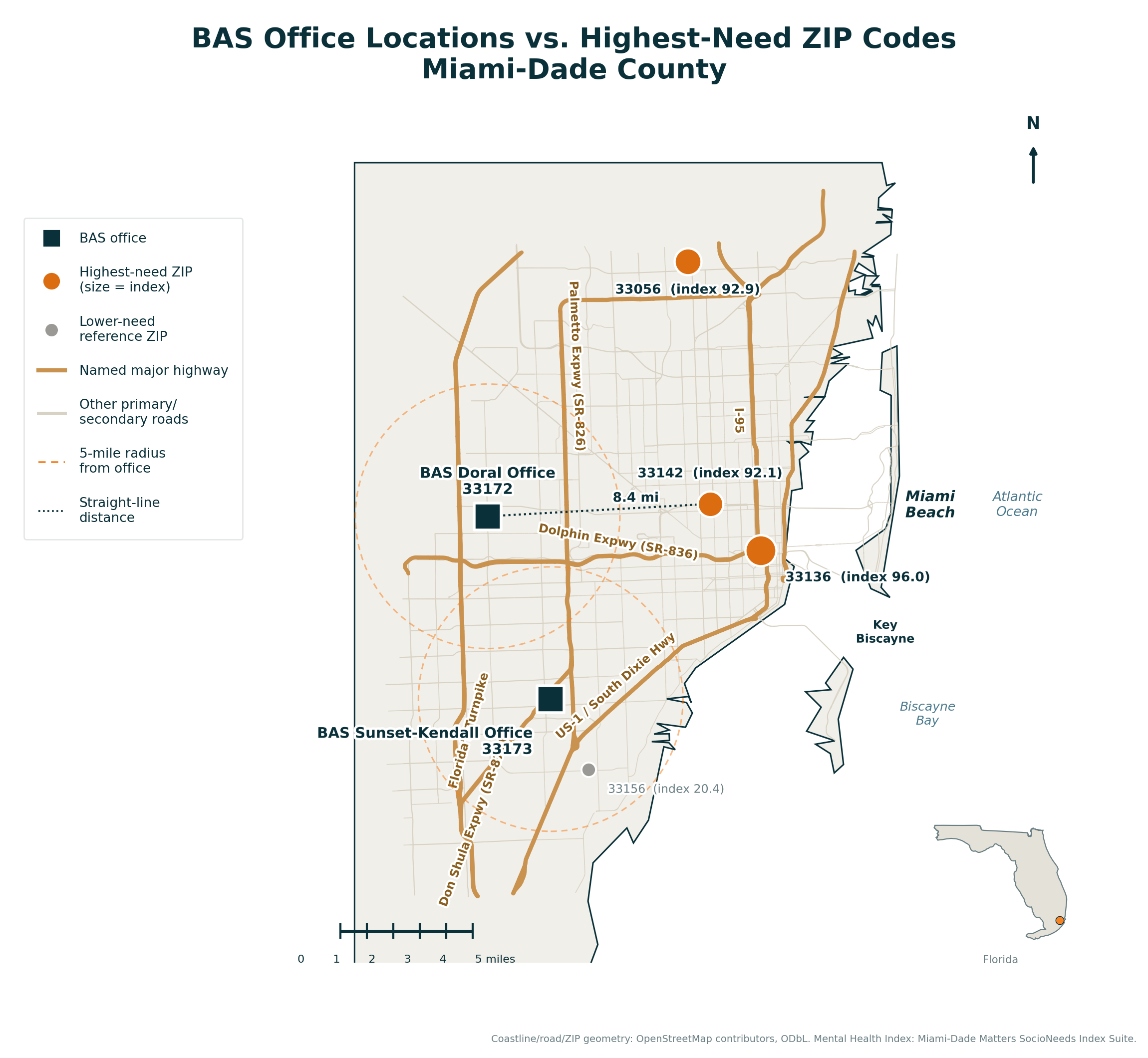
Miami-Dade's Mental Health Index (a 0–100 composite of access, health, and socioeconomic factors, where higher = greater need) sits at 61.7 countywide, but individual ZIP codes run far higher: 33136 (96.0), 33056 (92.9), and 33142 (92.1) all score well above the county average. Notably, both of BAS's own offices, Doral (33172) and Sunset-Kendall (33173), sit in ZIP codes with below-average need. That's by design, not a gap in coverage: Targeted Case Management is offered on-site at both locations, which were deliberately chosen along well-connected public transit routes and near major roadways: easy to reach for clients coming from the higher-need communities nearby, not just the immediate ZIP code. BAS also serves those closer, higher-need ZIP codes directly, and case managers spend much of their work in the community rather than behind a desk.
Frequently Asked Questions
Do I need a license to be a case manager in Florida, or just certification?
CBHCM is a certification, not a professional license like an LCSW or LMHC. It's issued by the Florida Certification Board and is the credential Florida Medicaid requires for billing targeted case management services under s. 394.4573, Florida Statutes.
What's the difference between CBHCM and CBHCM-P?
CBHCM-P (Provisional) is for candidates who've met the education and training requirements but haven't yet reached 2,000 hours of qualifying work experience. It lets you work and bill while you finish accruing hours toward full CBHCM certification.
Can I start working as a case manager before I'm certified?
Yes. Most people gain their qualifying hours while employed, often under the Provisional pathway. This is the normal, expected route rather than an exception.
Does my degree need to be in social work or psychology?
No. A bachelor's degree in any field meets the education requirement, though coursework in a human-services-related field can make the 50-hour training easier to complete.
Do Certified Behavioral Health Case Managers only work with Medicaid clients?
No. TCM is a Medicaid benefit, so it covers Florida's full Medicaid population (including dual-eligible clients who carry both Medicare and full Medicaid) plus Florida's court and child-welfare systems, which have their own case-management coordination requirements.
Ready to put this credential to work? Behavioral Aid Solutions is hiring a Certified Behavioral Health Case Manager (TCM) in Doral and Sunset-Kendall, with full training support and supervision for candidates working toward or holding CBHCM certification.
This article was created with the assistance of AI and reviewed for clinical accuracy by a licensed member of the Behavioral Aid Solutions clinical team, with editorial review by a journalist.